Under a minute a case. A rate you can stand behind.
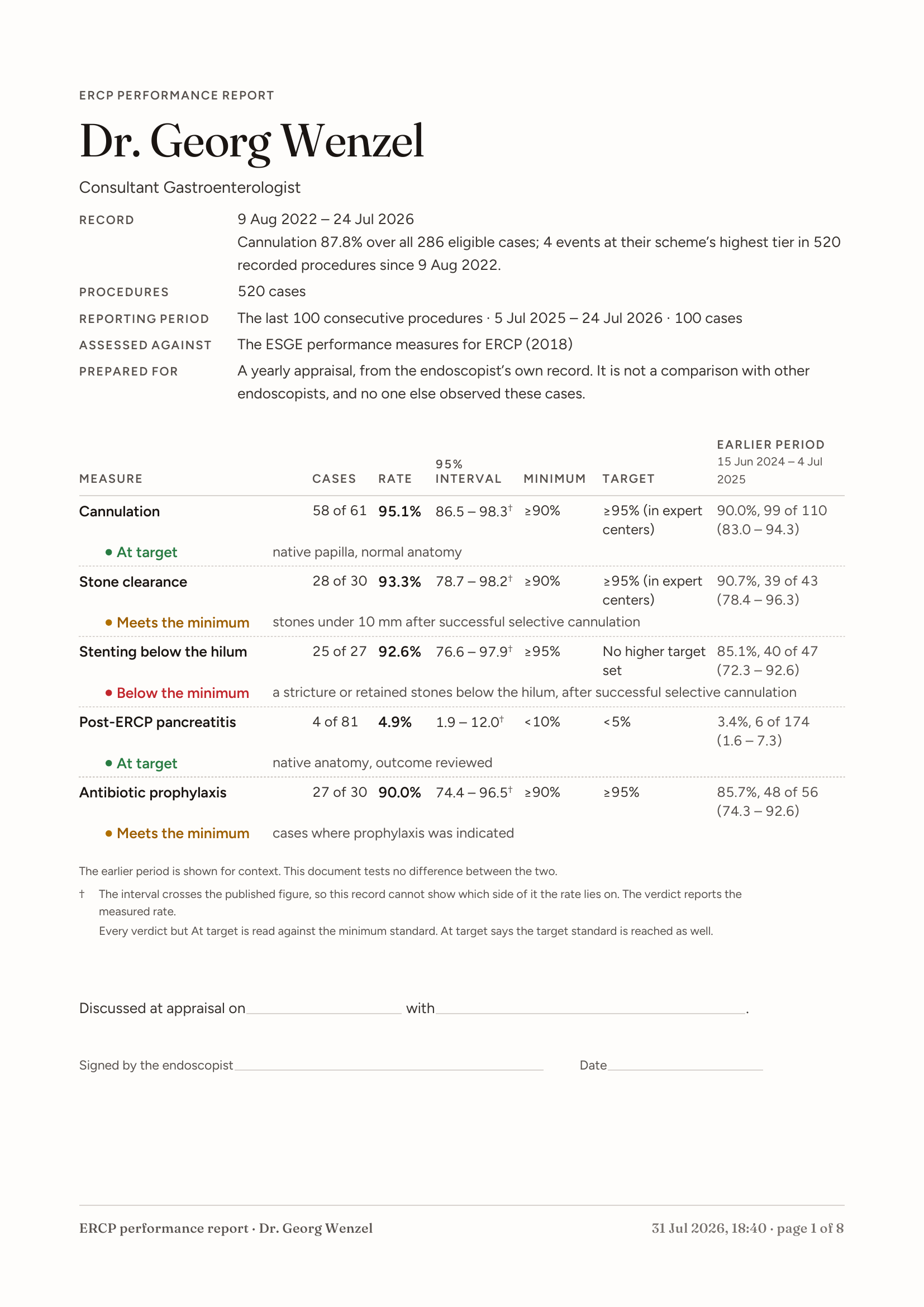
A logbook for your own ERCPs, kept on your phone and encrypted there. It reads your cases against the published standards, and prints the document you hand over at the end.
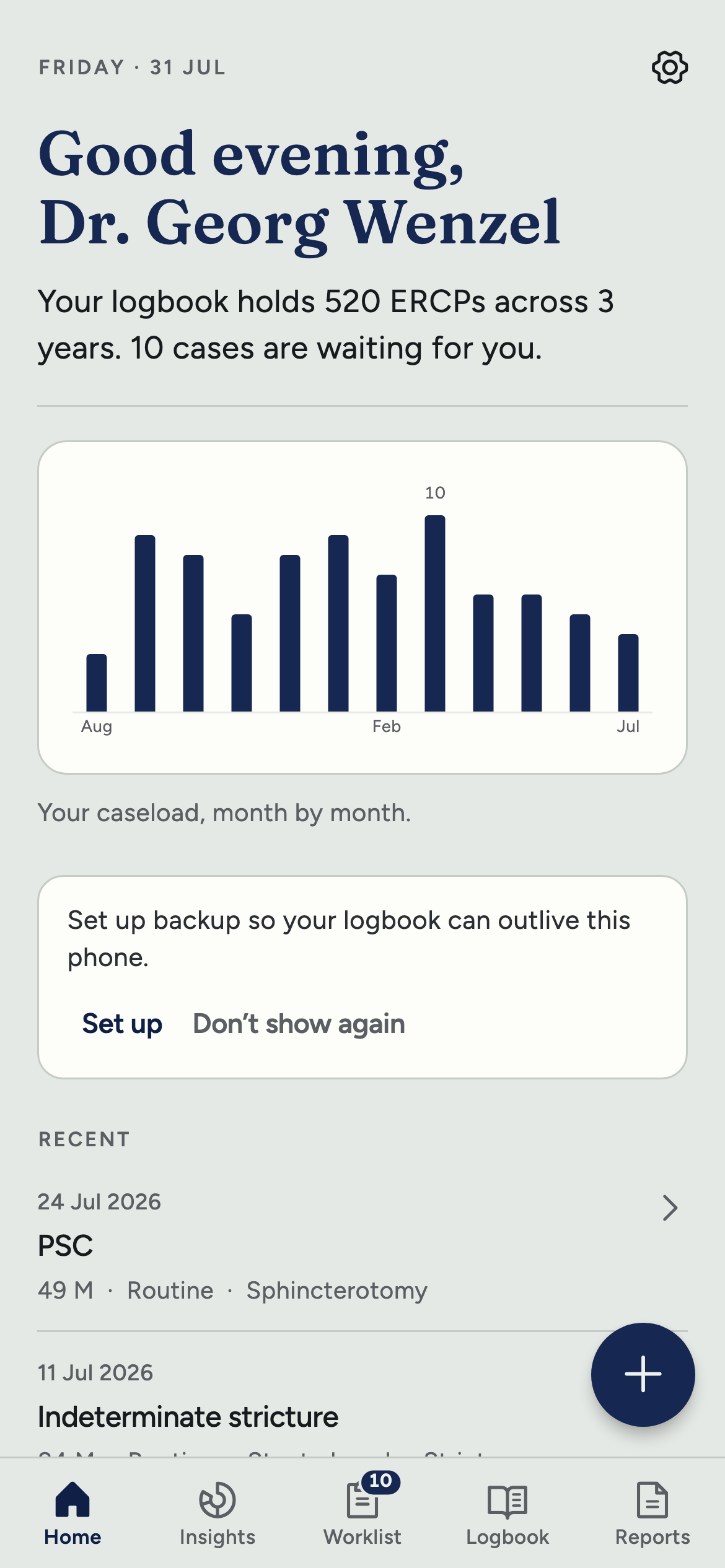
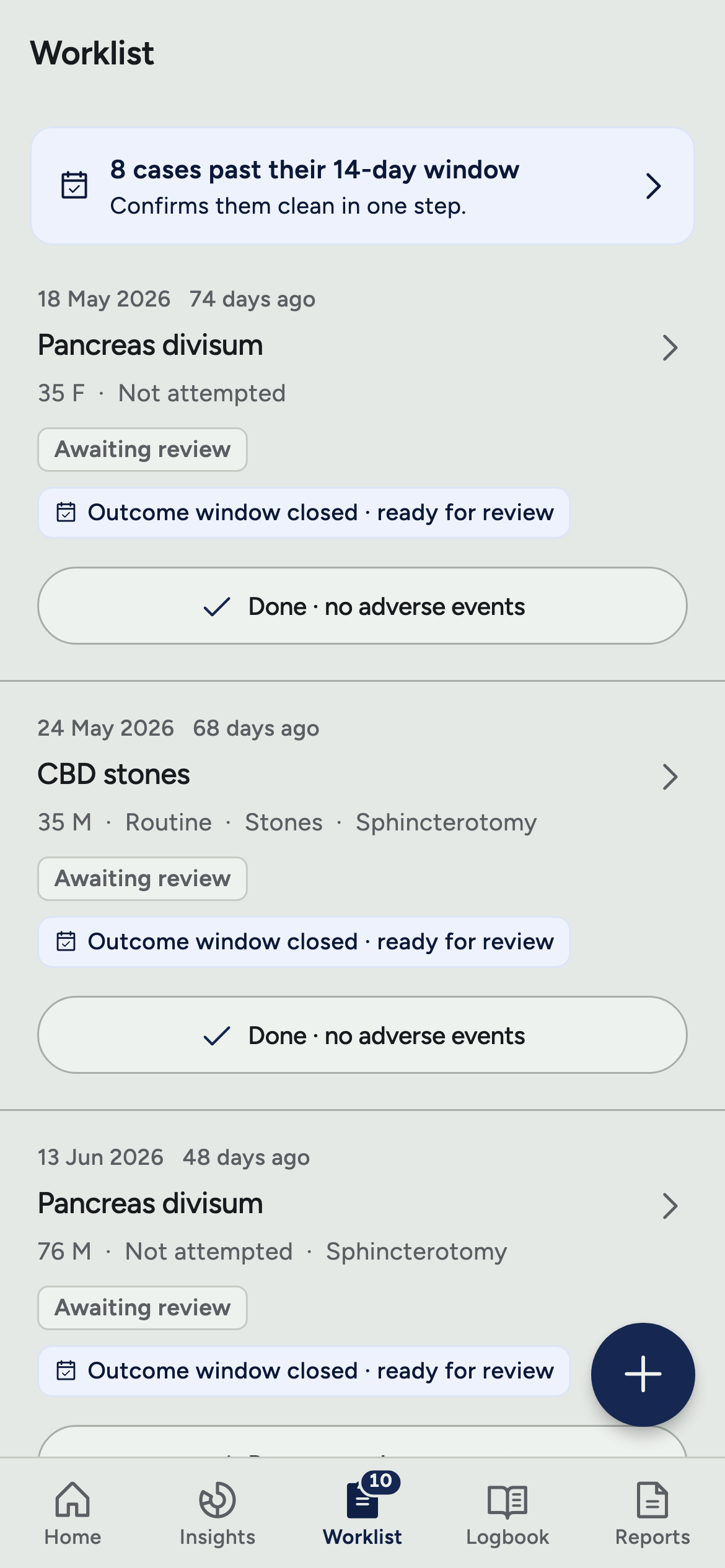
Your training happens case by case. So can your evidence.
It ends in a dossier your supervisor signs.
You perform hundreds of ERCPs every year. This shows you what they add up to.
It ends in a report you take to appraisal.
Walk in with a document, not an impression.
Generated on your device, from your own record.
While you are training
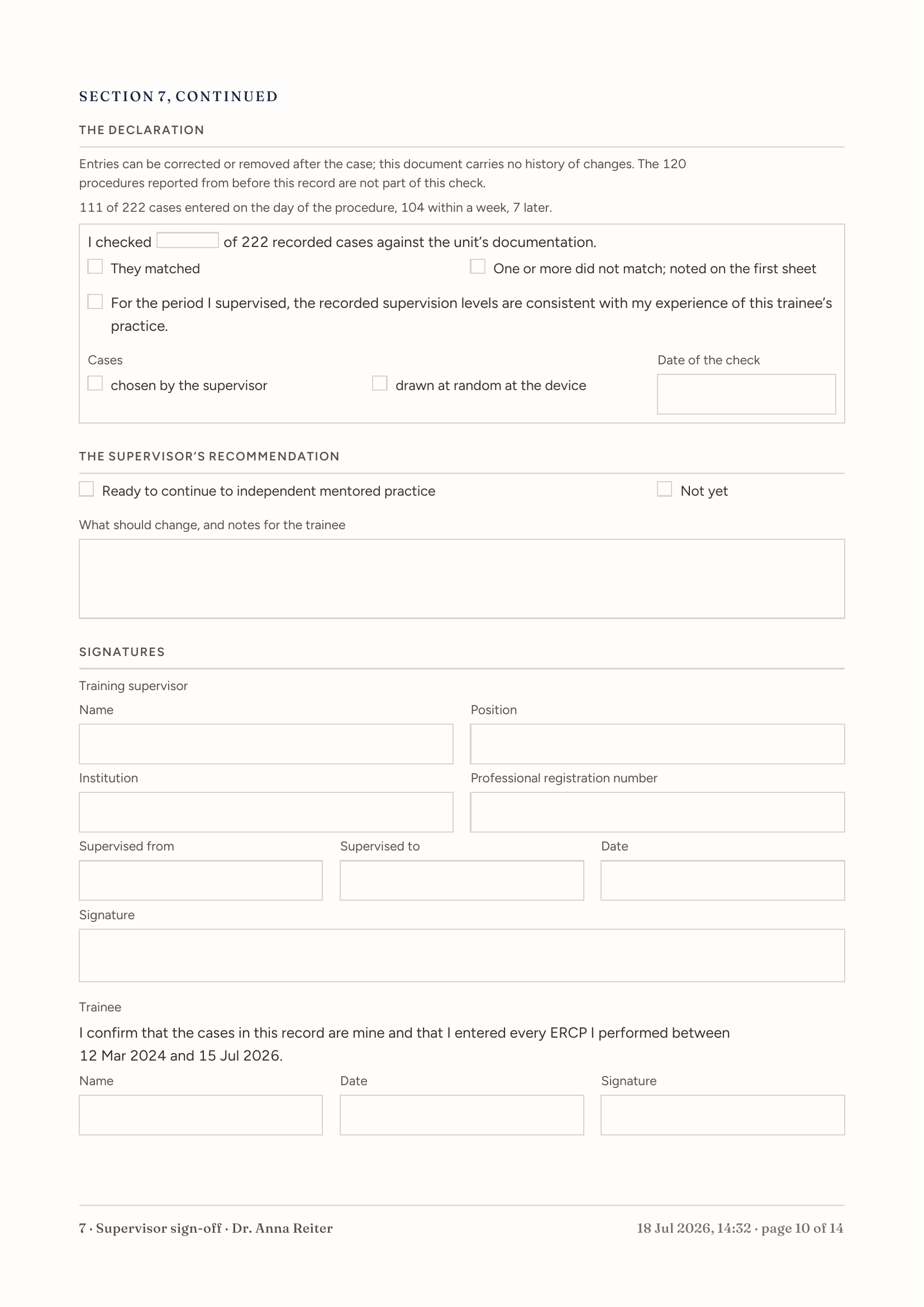
The training evidence dossier
Your volume, your rates, your supervision levels and your attainment curve, with the sheet your supervisor signs.
Every year after
The performance report
A year of practice, ready for appraisal. Cited, dated, and signed by you.
Once training closes, one document does the work of both: the year, the measures, the adverse events, the denominators, with the citations attached, so the conversation is about your practice rather than about where the numbers came from.
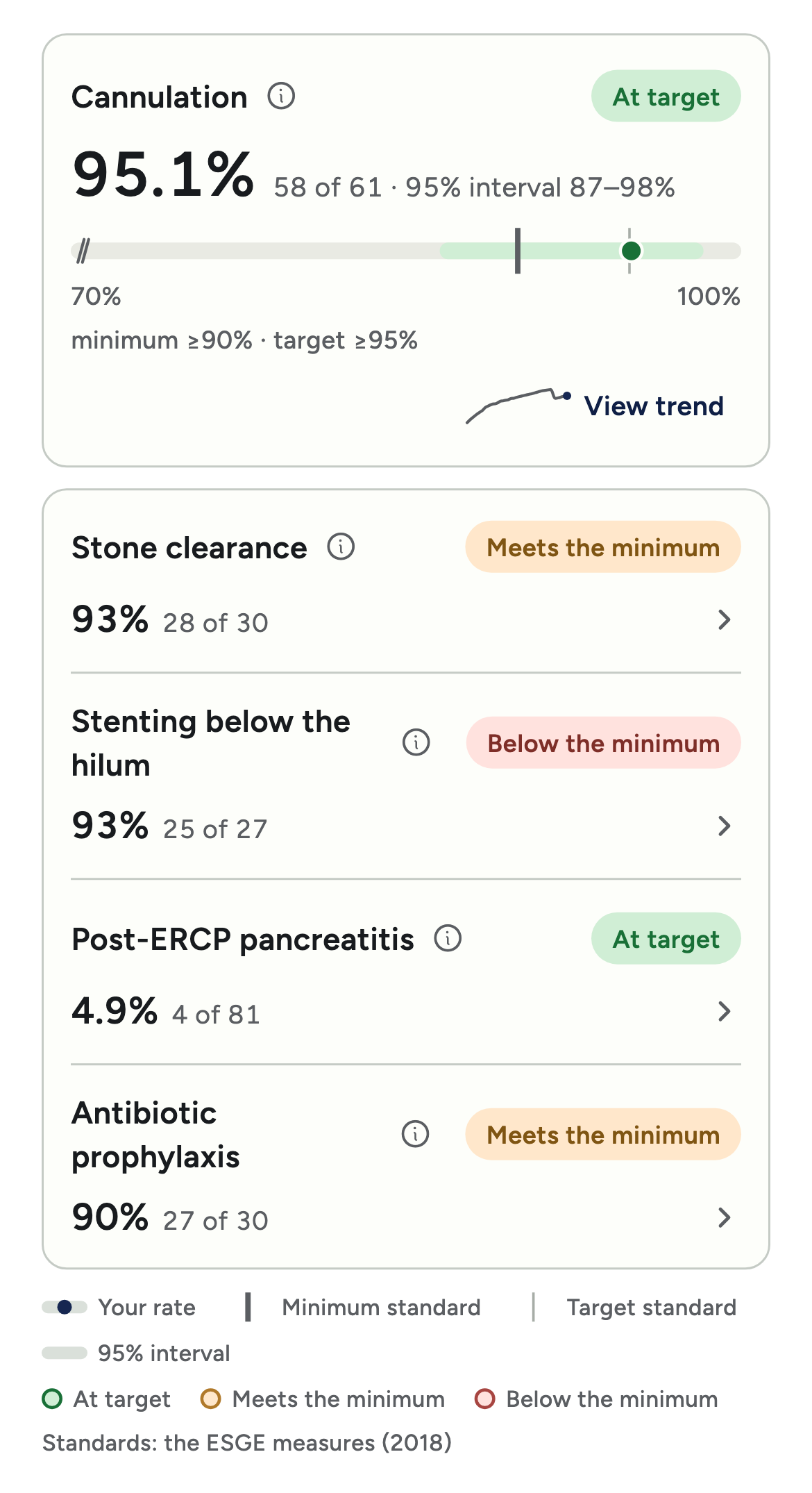
Every rate carries its denominator and its confidence interval. It tells you when it doesn’t know.
Five measures, one screen, ten seconds. Each rate is read against the ESGE’s minimum standard and its stricter target standard: At target once it reaches the target standard, Meets the minimum between the two, Below the minimum under the minimum standard. Pancreatitis counts harm, so lower is better, and the same three bands read At target, Within the limit and Above the limit. While you train, the figure the ESGE curriculum for ERCP training (2021) sets for your stage is the minimum. Nothing is rounded in your favour.
Not yet reported
A rate prints from 20 eligible cases, a floor this app sets. Under that the measure says Not yet reported, gives the count and the floor, and nothing more. A small number pretending to be a rate helps nobody.
95% confidence interval (Wilson)⑤
The width of what is still unknown sits beside the rate, not in a footnote.
The same rate, twice. At twelve cases the interval is wide enough to fit excellent practice and poor practice at once. At eighty-seven it is a rate you can stand behind. That gap is why a measure stays quiet until then.
Five measures, exactly as the ESGE wrote them.
From the ESGE performance measures for ERCP (2018)①.
Deep biliary cannulation
of the native papilla, in normal anatomy
≥90%Minimum standard
Target standard 95%
(expert centres)
Stone clearance
for common bile duct stones under 10 mm
≥90%Minimum standard
Target standard 95%
(expert centres)
Stenting below the hilum
for biliary obstruction below the hilum, after successful cannulation
≥95%Minimum standard
Target standard 95%
Post‑ERCP pancreatitis②
every event graded for severity
<10%Minimum standard
Target standard <5%
Antibiotic prophylaxis
appropriate to the indication, before the procedure
90%Minimum standard
Target standard 95%
The ESGE suggests measuring each over at least a hundred consecutive procedures, or all of them if fewer①.
The next questions
What counts in each denominator?
Each measure counts the population the paper defines, and the app names that population behind the rate:
- the native papillae in normal anatomy where cannulation was attempted
- the bile duct stones under 10 mm after a successful selective cannulation
- the obstructions below the hilum after a successful cannulation
- the indications the paper names for antibiotic prophylaxis
The pancreatitis rate counts the cases whose outcome you have reviewed. A case still awaiting review is left out of the rate, and the count still waiting is printed on the pancreatitis rate’s own screen, so a rate never borrows credit from a case nobody has looked at yet.
Where does each figure come from?
The cannulation drift chart further down is anchored on the ESGE minimum standard, the attainment curve on the curriculum’s figure for your stage. One part is this app’s own and is written down: where the curve’s anchor sits at the first training stage.
What can you take off the phone?
Two documents, as PDFs: the training evidence dossier and the ERCP performance report. Each one leaves through the system share sheet, or saves into a folder you pick. Your notes are in neither of them.
The whole logbook as one spreadsheet, from Settings: every case, notes included, in words rather than codes. It leaves the same way and goes only where you send it. It is not encrypted, so anyone who has the file can read it.
And an encrypted backup of the whole record, notes included: you switch it on once, and it keeps itself current in a folder you pick on Android, or in iCloud Drive on an iPhone. Two documents, a spreadsheet and a backup, and nothing leaves until you send it or switch the backup on.
Were the cases harder, and was the pancreatitis avoidable?
Your cannulation rate again, split by the predicted difficulty of the case④, and your pancreatitis rate split by recorded risk with the definition of high risk printed beside it⑥. Each split keeps its own count, and one with fewer than 20 cases behind it stays quiet.
No split is given a standard of its own, because no paper publishes one. The published standards judge a whole cohort, so the app never re-scores your rate against your own case mix.
The context sits beside the number. It never adjusts it. A harder case mix explains a rate. It does not move the standard you are held to.
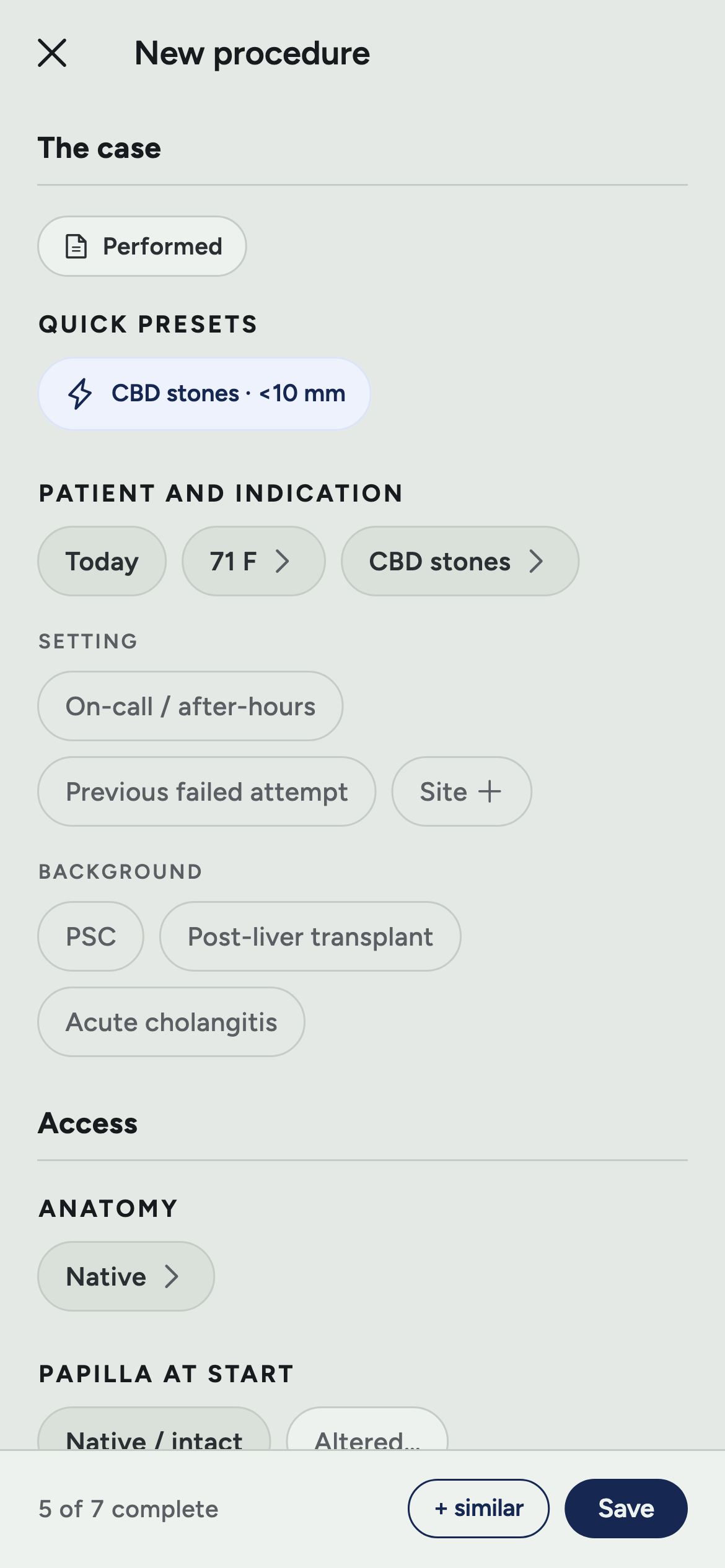
From memory, one thumb, before you leave the room.
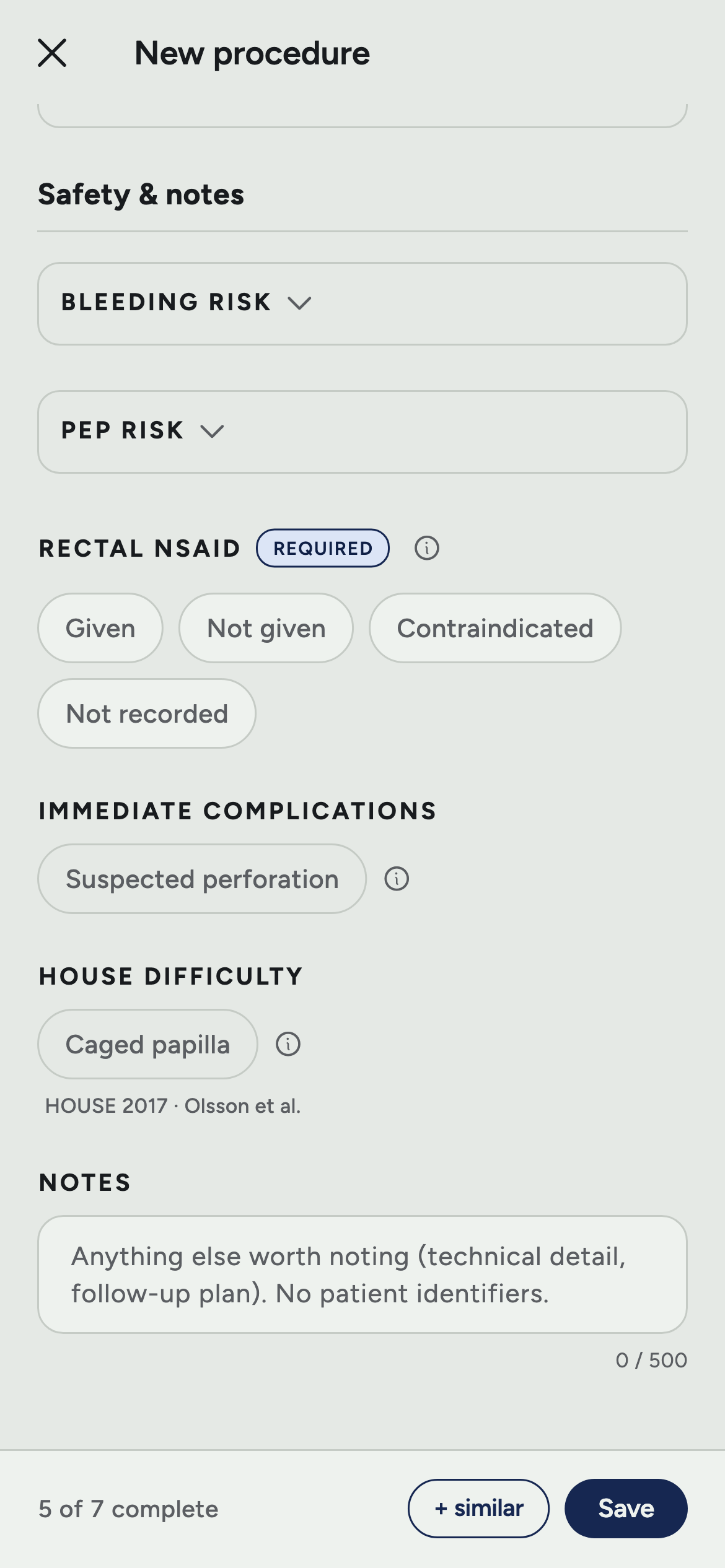
Chips, not typing. You type the age, a few words when the indication is Other, and an optional note at the end; everything else is a tap. Every question can be answered right after the case. No timestamps, no console readings, no chart lookup.
Your own shortlist. The indication picker opens on the five you picked most over the last ninety days. All 27 stay one tab away.
Save walks you to the gaps. Save is never greyed out. Tap it with something missing and it scrolls you to the first gap and asks. An entry you had to abandon is offered back when you return.
Every rate updates the moment you save.
The standard moves with your career. The record underneath it does not.
Two questions, two instruments. One asks whether the evidence is there yet. The other asks whether you are still there.
The attainment curve · while you train③⑦
Is the evidence there yet?
Evidence that you cannulate at 80%, the curriculum’s figure for supervised training. The curve climbs with every success and falls back with every failure, and the app says where it has got to: not yet enough evidence and how far along it is, or enough evidence since a named case. The method is a learning-curve cumulative sum (LC‑CUSUM). It draws the curve your trainer reads to decide. It does not decide. A good week is not competence.
The cannulation drift chart · after that①⑦
Am I still there?
This one never finishes. The score is held to a floor at zero, rises with each unsuccessful case and falls back with each success, so only a run of them reaches the line. When it reaches the line marked worth a re-read, the app says so and names the cases.
The curriculum grades its learning-curve recommendations on moderate evidence, and the rest on low or very low③. The app draws your curve case by case: one input for your trainer’s decision, not a substitute for it.
What does the curve tell a trainee?
One thing, and it answers yes or no: has the run of work been good enough for long enough to be unlikely to be luck.
There is no server to breach. Because there isn’t one.
It never asks for a patient name or a hospital number. The measures never needed them.
If you lose the phone
A logbook that lives on one phone is worthless the day the phone goes. So there is an encrypted backup you hold and restore yourself. Your key, and a place you chose.
You shouldn’t have to take my word for it.
The methods are the papers’ own, so anyone who reads the papers can read the record. No society has endorsed this app.
The references on this page
The logbook is yours.
Version one was a website I built for myself. I ran it on a machine at home, used it on my own cases, and took it to Milan and Istanbul to show colleagues.
It taught me two things and warned me of a third. It needed a connection, and the endoscopy unit is the one place that does not reliably have one. It needed an account, and signing in to a server to reach your own cases is friction at the worst possible moment. And if I had ever opened it up to anyone else, I would have become the keeper of their records. That is a job nobody should have to trust me with.
So version two is a phone app. Your thumb opens it, and your cases never wait on a server. The record leaves the phone only in a file you share or a backup you switched on.
I am Lukas Erhart, an interventional endoscopist in Austria. I log my own ERCPs with this, which makes me user number one and the most impatient person it has. I build it after hours.
Presented at ESGE 2026 in Milan and IAP 2026 in Istanbul.
The first 20 cases are free. Then €99 a year, one tier. If you stop, everything you recorded stays on your phone, still opens, still backs up, still prints; only the next new case waits.
When exactly does it ask you to pay?
Not until 20 of your cases count toward your cannulation rate and the rate prints, so nobody is asked to pay for a number they have not seen.
One address, nothing else